

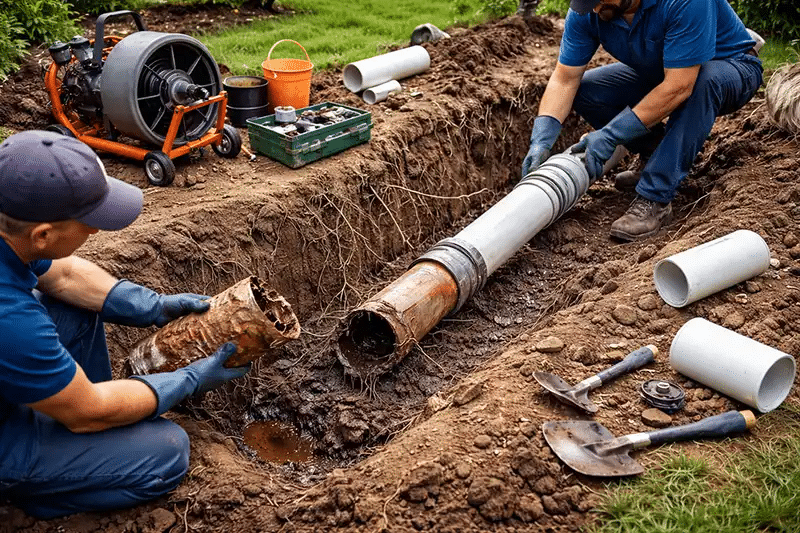
Once you’ve decided your home needs sewage line replacement, the practical questions start piling up. How many days will this actually take? Is your yard going to look like a construction zone? Who’s dealing with the city permits, you or the plumber? These aren’t small details. They affect whether you need to take time off work, board the dog somewhere else for a week, or warn the neighbors before a crew shows up with excavation equipment.
The short answer: most residential sewer line replacements take anywhere from 1 to 8 days, depending on whether the work is trenchless or traditional excavation, how much of the line needs replacing, and how quickly permits come through. Trenchless methods usually finish faster and disturb far less of your yard. Permits are almost always required and are typically handled by your contractor, not you. Here’s how each part of the process actually plays out.
Contents
- Step 1: Diagnosis and Camera Inspection
- Step 2: Permits, and Who Actually Handles Them
- Step 3: Excavation or Access Point Setup
- Step 4: Installing the New Line
- Step 5: Backfilling, Restoration, and Final Inspection
- How Long Does the Whole Process Take?
- What Yard Impact Actually Looks Like
- Living Through the Process
- Getting an Accurate Timeline for Your Home
- Your septic and sewer systems deserve expert care. Trust Tri-County Water Services for fast, reliable, and transparent services that ensure your system stays trouble-free across PA and MD.
- Frequently Asked Questions
- / Author
- Brent D. Hershey
- Orenco Rep, Educator
Step 1: Diagnosis and Camera Inspection
Before any digging happens, a technician runs a camera down the line to confirm exactly what’s wrong and how much of the pipe is affected. This step usually takes one to two hours for most homes, though it can stretch to a full day if access is tricky or the property is large. The camera footage shows pipe material, condition, and the exact location of any collapse, crack, or root intrusion, which determines whether you’re looking at a partial or full replacement, and which method makes sense.
This is also the point where your sewer services provider will walk you through your options and give you a realistic estimate rather than a guess.
Step 2: Permits, and Who Actually Handles Them
Yes, you need a permit. Sewer line work connects to the public sanitation system, so it’s treated as regulated plumbing work in almost every municipality, whether you’re doing a full dig-and-replace or a trenchless pipe burst. The good news is that a licensed contractor typically manages this step for you, submitting the application, paying the fee, and scheduling any required inspections.
Permit turnaround time varies widely by location. Straightforward residential permits are sometimes approved within a few business days, while more complex projects, especially ones that cross a sidewalk, street, or public right-of-way, can take one to two weeks. Permit fees generally run in the low hundreds of dollars, and that cost is usually already built into your project quote rather than billed separately.
If your line backs up and becomes an emergency before a permit is in hand, the physical repair still typically gets prioritized to stop the immediate damage, with the permit paperwork filed as soon as things stabilize. Skipping the permit step entirely isn’t an option. Unpermitted sewer work can create real problems later, from fines to complications when you eventually sell the house.
Step 3: Excavation or Access Point Setup
This is where trenchless and traditional methods really diverge, and it’s the part that most affects your yard.
Traditional excavation involves digging a trench along the full path of the old sewer line to expose it for removal and replacement. Depending on depth, soil conditions, and whether the line runs under a driveway, patio, or the street, this step alone can take one to three days. Deeper lines, ones running under hardscaping, or projects that extend into the street generally take longer than a straightforward yard-only excavation.
Trenchless replacement, using pipe bursting or similar methods, only requires two small access points, one near the house and one near the connection point, rather than a trench along the entire run. A bursting head shatters the old pipe while pulling a new one into place behind it. This dramatically reduces both the time and the yard disruption compared to traditional digging, and it’s become the preferred method for most residential pipe repair and replacement work where site conditions allow it.
Step 4: Installing the New Line
Once the old pipe is out or burst through, installing the new line generally takes one to two days for traditional jobs, or can be completed within the same day for trenchless work. Most homeowners today choose PVC or HDPE piping, which is more durable and less prone to root intrusion or cracking than the clay, cast iron, or Orangeburg pipe it’s replacing. The new line gets pressure tested and inspected before backfilling begins, to confirm proper flow and a leak-free connection to both your home’s plumbing and the municipal sewer or septic system.
Step 5: Backfilling, Restoration, and Final Inspection
For traditional excavation, this final stage involves filling the trench, compacting the soil properly so it doesn’t settle unevenly later, and restoring any landscaping, sod, mulch beds, driveway sections, or walkways that were disturbed. This can add another day or two depending on the scope of restoration needed. Trenchless jobs skip most of this step entirely, since only the small access points need to be filled and patched.
A final inspection, usually required as part of your permit, confirms the work meets code before the project is considered closed out.
How Long Does the Whole Process Take?
Putting it all together, here’s a realistic range for most residential jobs:
- Trenchless replacement: often 1 to 3 days of actual work, plus permit turnaround time before the crew arrives
- Partial traditional replacement (a section of the line, not the full run): typically 1 to 3 days of excavation and installation
- Full traditional replacement (house to street): commonly 3 to 8 days, factoring in excavation, installation, and yard or hardscape restoration
Add permit processing time on top of the physical work, which can range from same-day to two weeks depending on your municipality and how complex the project is. Weather, soil conditions, and how deep the line sits can all shift these numbers in either direction.
What Yard Impact Actually Looks Like
If your project uses trenchless methods, expect two neat access holes, typically a few feet across, rather than a torn-up lawn. Most homeowners are surprised at how little evidence remains once the access points are patched.
Traditional excavation is more visible. Expect a trench along the pipe’s path, temporarily disturbed grass or landscaping, and possibly a section of driveway, patio, or sidewalk that needs to be cut and later repaired. A reputable contractor will compact the soil properly during backfill and restore hardscaping to prevent future settling or cracking. It’s worth asking your provider directly what restoration is included in your quote versus what you’d need to handle separately, like reseeding grass or replacing mature landscaping.
Living Through the Process
During excavation and installation, you may be without sewer or water service for part of the project, so it’s worth asking your contractor for a specific window rather than assuming service stays uninterrupted the whole time. If your home is on a septic system rather than municipal sewer, coordinate with your provider on how septic services factor into the timeline, since access to the tank may also be part of the work area.
Financing is worth asking about too, especially for larger traditional replacement jobs. Financing options can spread the cost out instead of requiring the full amount upfront.
Getting an Accurate Timeline for Your Home
Every property is different, and the only way to get a real timeline instead of a general range is to have your line inspected and your site conditions assessed directly. Depth, soil type, pipe material, distance to the street, and whether hardscaping is involved all shift the schedule.
If you’re planning a sewage line replacement or dealing with a backup that needs urgent attention, contact Tri-County Water Services for an inspection and a clear, honest timeline. We serve homeowners throughout our service areas across Pennsylvania and Maryland, and we handle the permitting process so you don’t have to navigate it alone.
Frequently Asked Questions
Q: How long does sewer line replacement typically take?
A: Most residential jobs take between 1 and 8 days, depending on the method and scope. Trenchless replacement often finishes in 1 to 3 days, while a full traditional dig-and-replace from house to street can take 3 to 8 days including restoration.
Q: Do I need a permit to replace my sewer line?
A: Yes, almost every municipality requires a permit for sewer line replacement since it connects to the public sanitation system. Your contractor typically handles the application, fees, and inspection scheduling as part of the project.
Q: How long does it take to get a sewer permit approved?
A: It varies by location, but straightforward residential permits are often approved within a few business days to two weeks. Projects that involve work in a public street or right-of-way can take longer due to additional review.
Q: Will sewer line replacement destroy my yard?
A: It depends on the method. Trenchless replacement typically requires only two small access points and leaves minimal visible disruption, while traditional excavation involves a trench along the pipe’s path and may require restoring landscaping or hardscaping afterward.
Q: Will I be without water during sewer line replacement?
A: You may be without sewer or water service for part of the project, particularly during excavation and the connection stage. Ask your provider for a specific timeframe so you can plan around it.
Q: Is trenchless sewer line replacement always faster than traditional replacement?
A: In most cases, yes, since it avoids digging a full trench and requires far less restoration afterward. However, site conditions like severe pipe collapse, unusual routing, or certain pipe materials can occasionally make traditional excavation the more practical choice.
Q: What happens if my sewer line backs up before I can get a permit?
A: Emergency situations typically get addressed immediately to stop damage to your home, with permit paperwork filed as soon as the situation is stable. If you’re dealing with an active backup, contact us right away for emergency service.

